Competitive Agriculture Foods and renewable energy products from tapioca.
Since 1945, Our group are supplying premium starch sugar products and Fuel Ethanol
1945
Worldwide
Certified
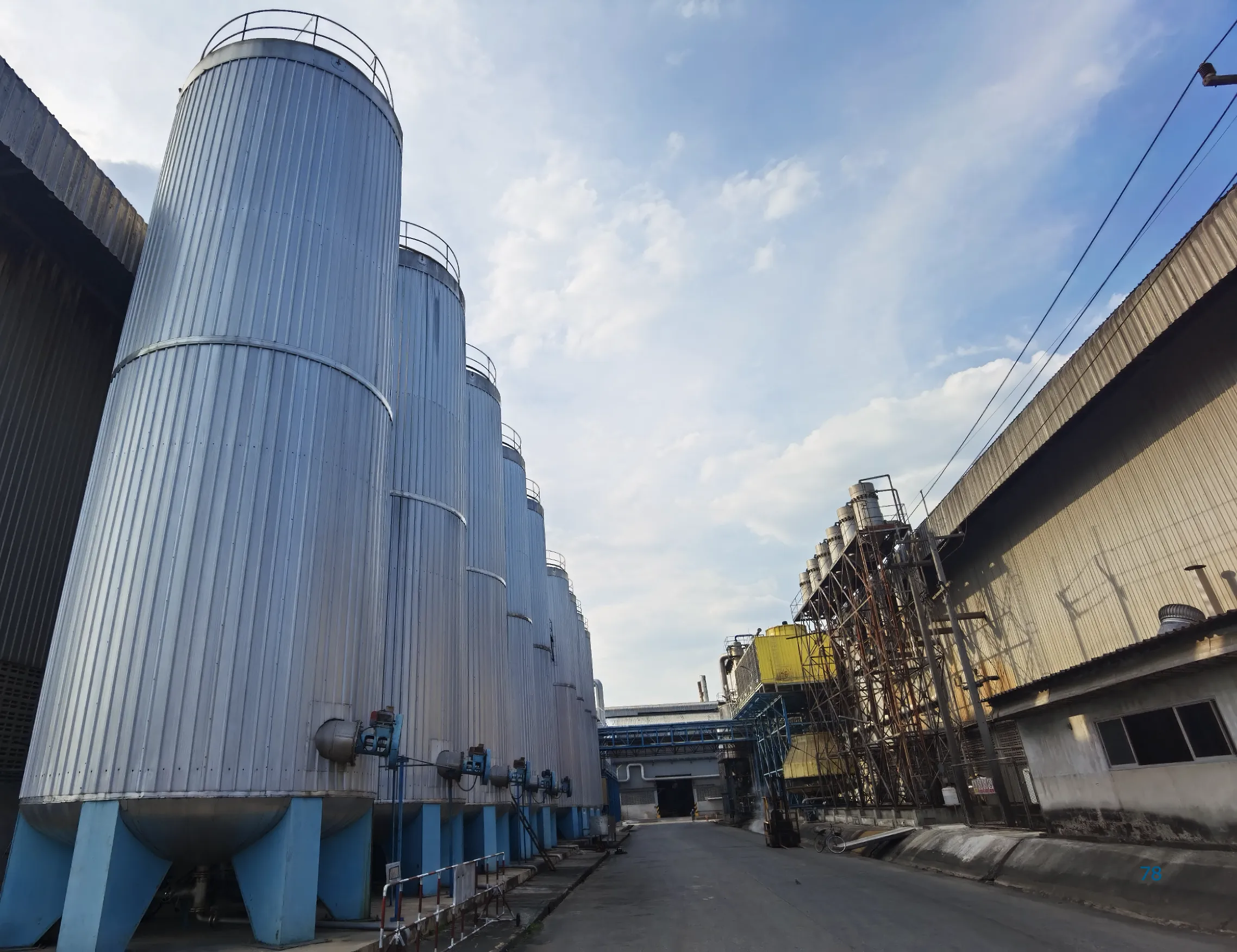
About P.S.C. Group
The P.S.C. Group is a conglomerate operating in the tapioca (cassava) industry since 1945. Driven by a visionary approach and a strong commitment to continuous development, the P.S.C. Group has emerged as an industry leader with world-class operations today.
The P.S.C. Group consists of five core business categories:
Starch Sugar Industry
Ethanol Industry
Steel Industry
Dietary Supplements Industry
Our Philosophies: P.S.C.
- P - Product Quality
- S - Starch Products and Derivatives Focus
- C - Customer Satisfaction
Developing standards alongside quality to deliver the best starch products for our customers.
P.S.C. Philosophy
Global Certifications & Standards
We take pride in being a Thai company operating at international standards. To ensure the highest quality of our goods and services, our manufacturing processes are certified by global standards.
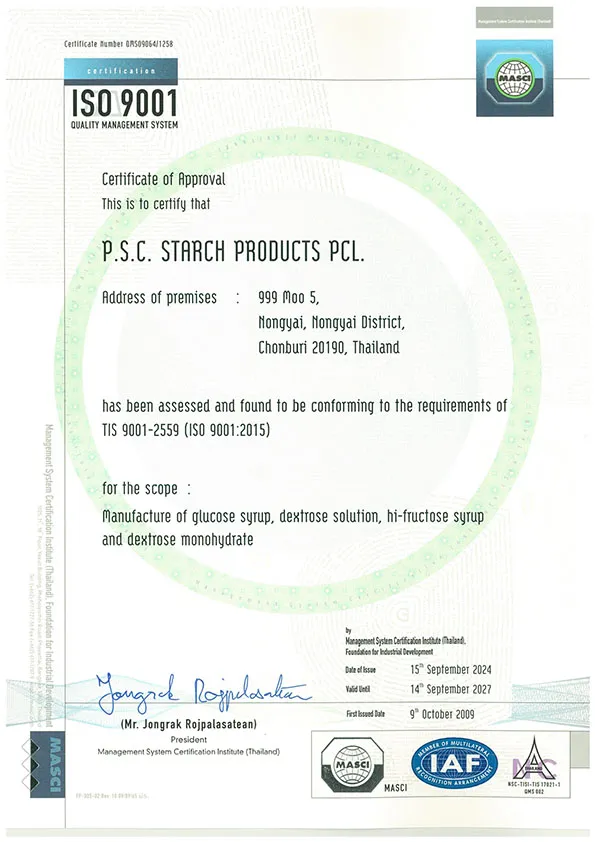
ISO 9001:2015
International standard for quality management systems
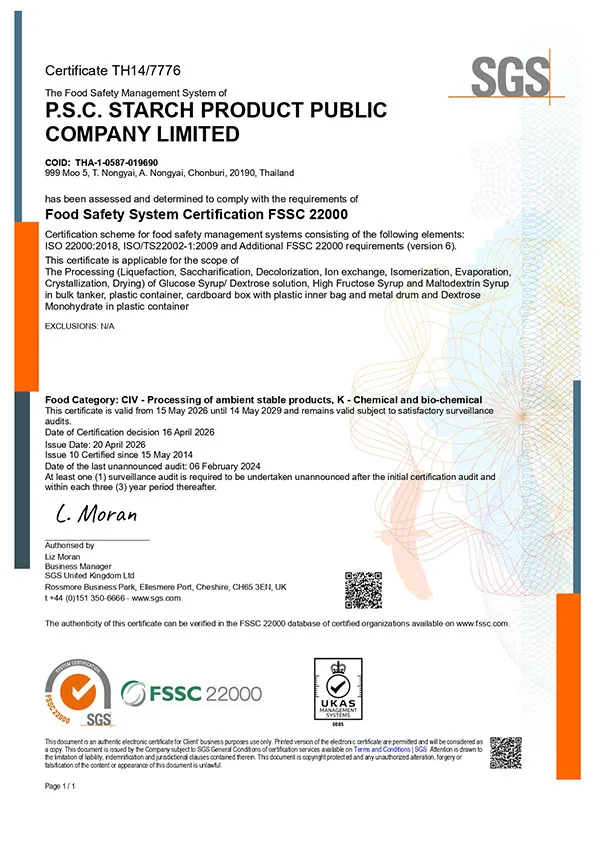
FSSC 22000
Food Safety System Certification
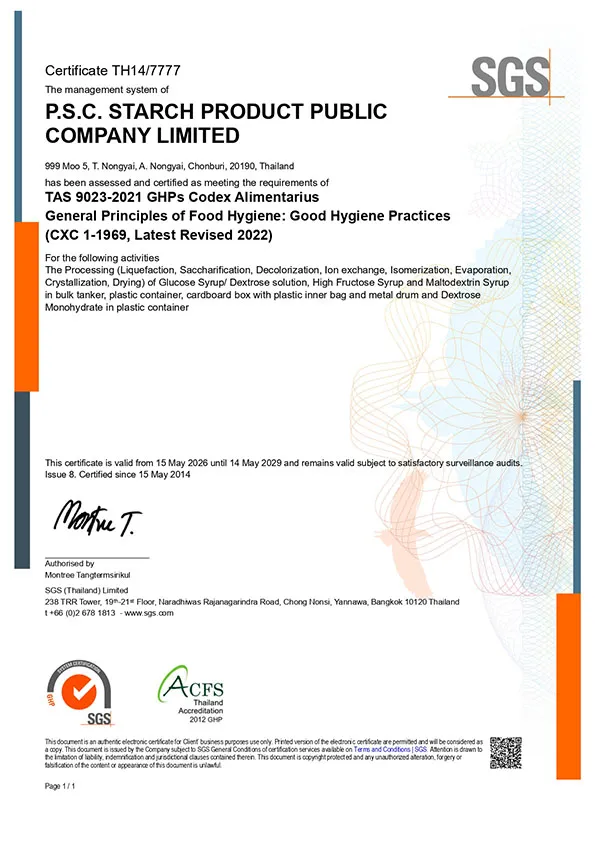
GHP
Good Hygiene Practice
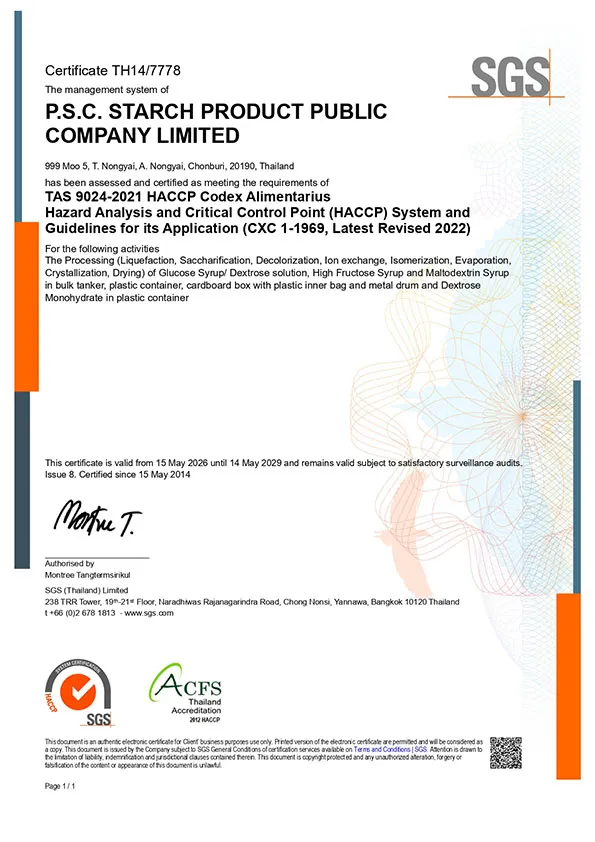
HACCP
Hazard Analysis Critical Control Point
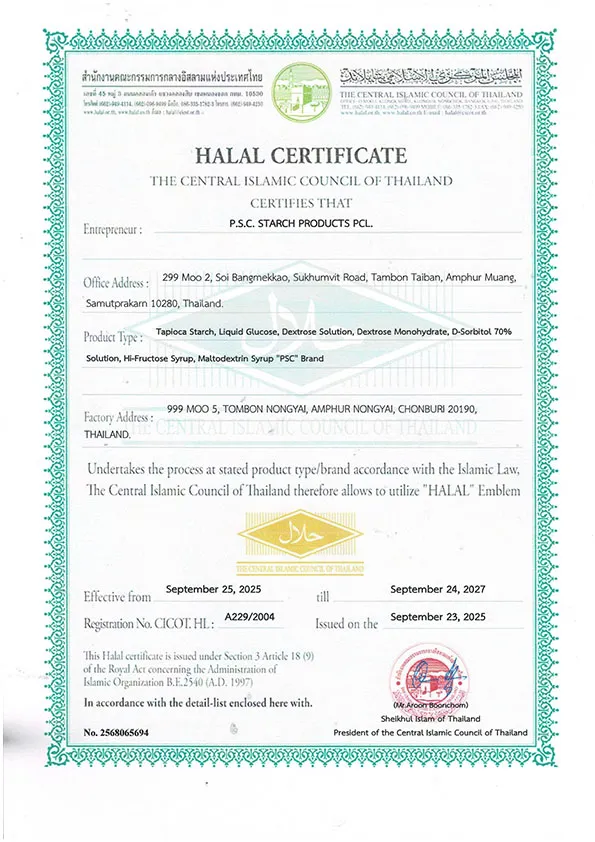
HALAL
Halal Certification
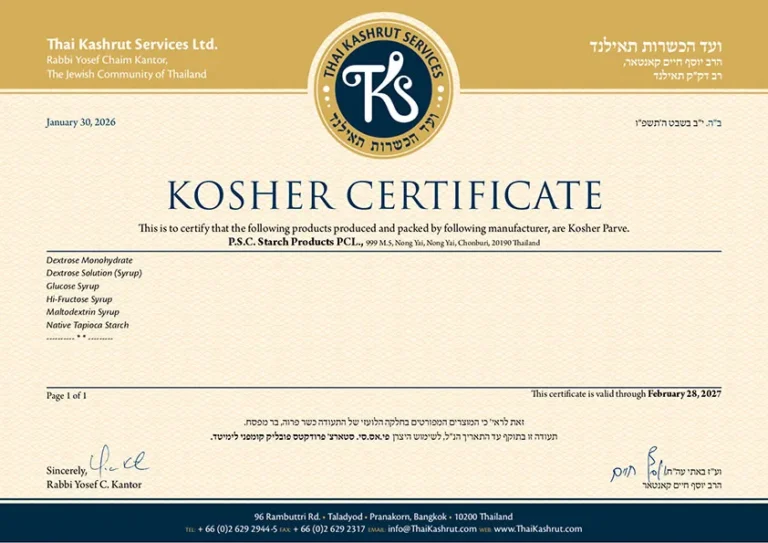
KOSHER
Kosher Certification
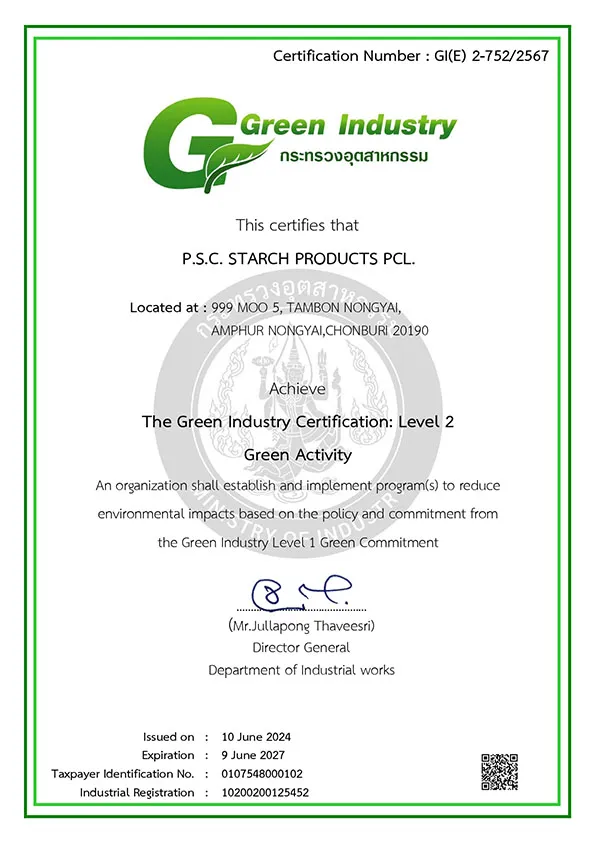
Green Industry Certification Level 2
Environmental management certification
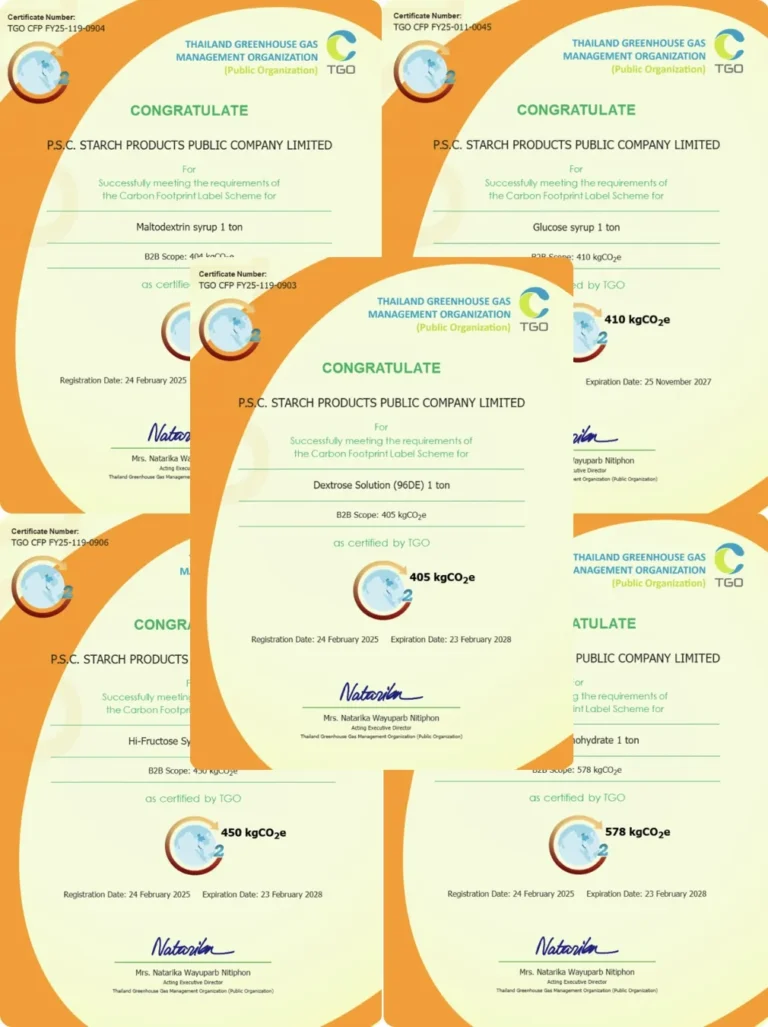
Carbon Footprint Label Scheme
Carbon footprint certification by products
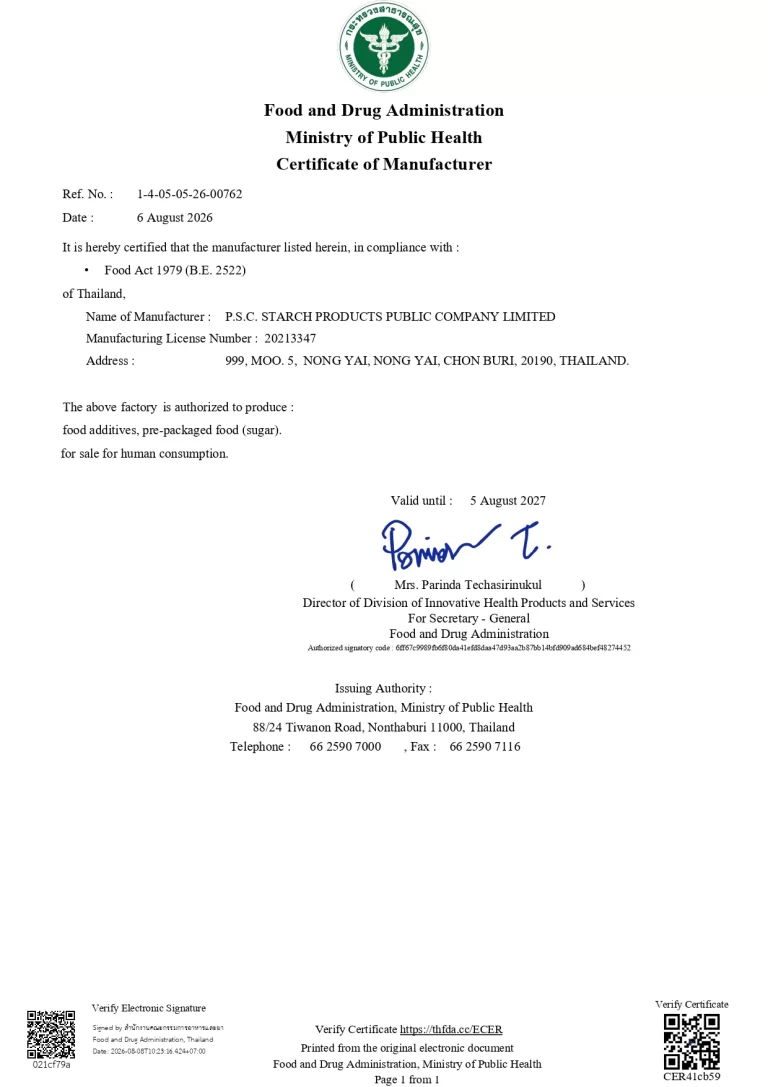
FDA Health Certificate
Food and Drug Administration health guarantee
Our Products
Our company core business is to produce and distribute tapioca starch, starch sugar and tapioca ethanol (in both fuel and industrial grades) from tapioca roots, chips and starch.
The company can categorize our major products as follow:
Tapioca or Cassava Starch
See Detail
Liquid Glucose
See Detail
Dextrose
See Detail
High Fructose Tapioca Syrup 42% (HFS 42P)
High Fructose Tapioca Syrup 55% (HFS 55P)
Anhydrous Ethanol (99.5%)
See Detail
Hydrous Ethanol (95%)
See Detail
Spirulina
See Detail
Delivery & Logistics
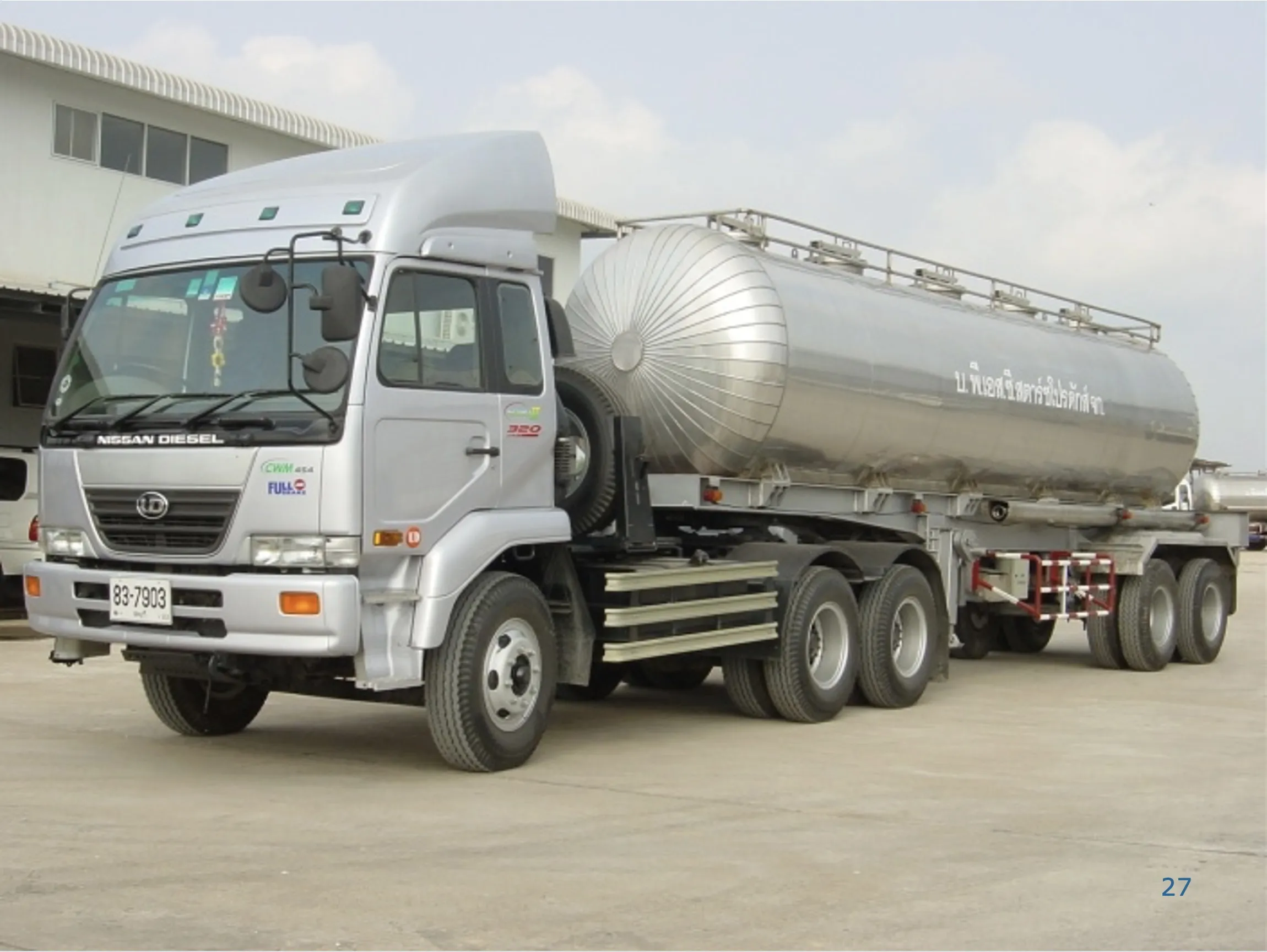
Starch sugar Shipping Methods
Stainless Steel Tanker Trucks
For large-volume liquid sugar product shipments.
Capacity: 15,000-30,000 kgs per truck.
SpaceKraft Box & IBC Containers
Large / Medium-volume flexible packaging options.
Capacity: up to 1,400 kgs per pallet.
Steel & Plastic Drums (200 Litres)
Small-volume flexible shipping options in food-grade polyethylene and epoxy-coated steel drums.
Capacity: up to 300 kgs per drum
Industrial Bags
Dextrose Monohydrate products shipping option in PP/PE Woven Bag (Polypropylene(PP) / Polyethylene(PE) or Kraft Paper Bags
Capacity: 25 kgs per bag
Ethanol Shipping Methods
Ethanol Tank Truck
ISO Tank Containers
Spirulina Shipping Methods
Corrugated Cartons
Spirulina packaging in double-layered PE and Aluminum foil bags packed in corrugated cartons.
Paper Drums with PE Liners
Bulk dry spirulina shipping option with inner food-grade PE bags on standard pallets.
Location Advantages
Laem Chabang Port
64 km
Suvarnabhumi Airport
110 km
Don Muang Airport
153 km
Company profiles
P.S.C. Starch Products PCL is one of the companies under P.S.C. group.
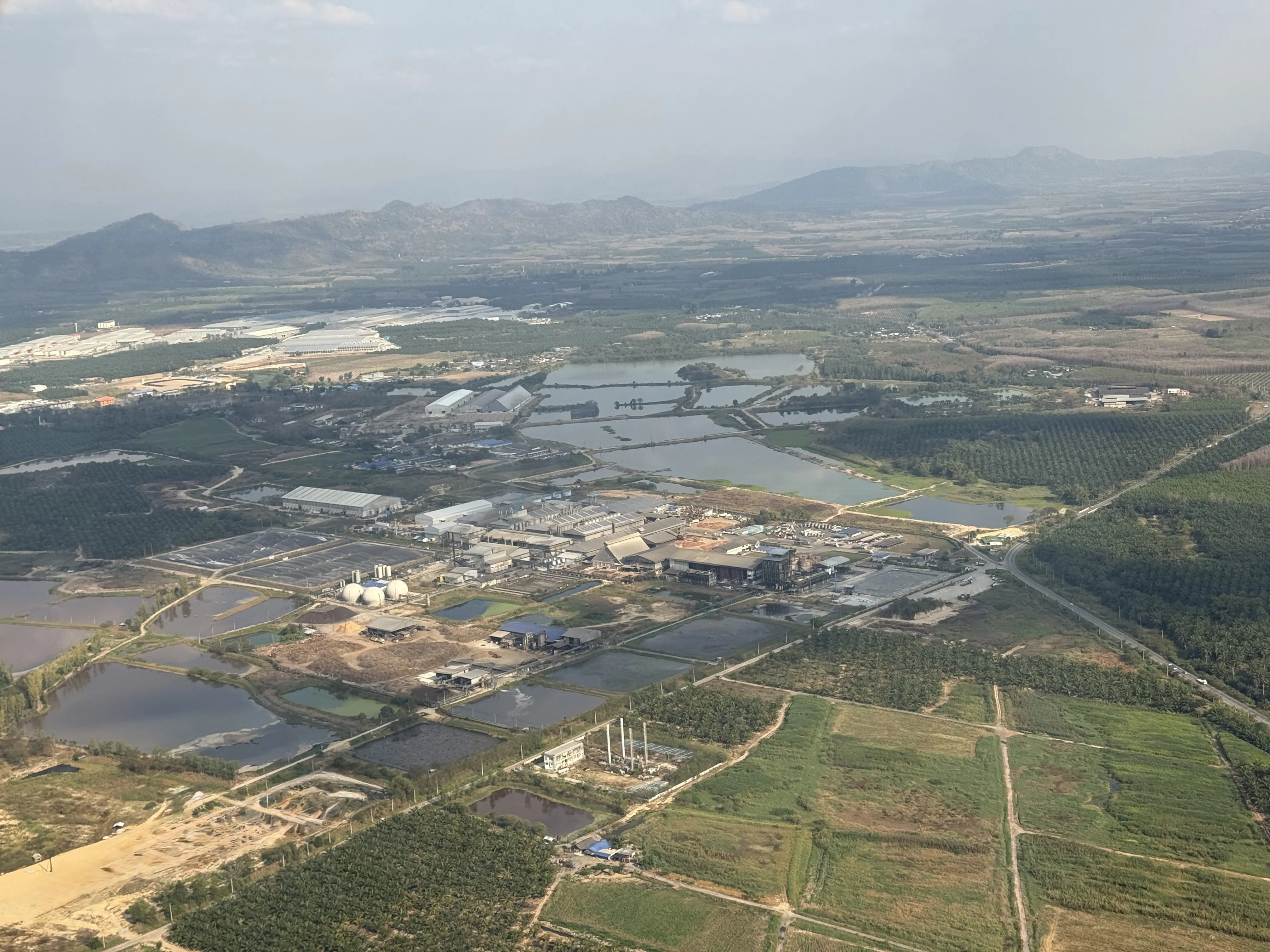
Under the group, the first company was established in year 1945 which was located in Eakkamai area, Bangkok. The company produced cane sugar as its major product. In year 1972, many types of Thai industries were expanded sharply especially in Agriculture Deep Processing industry. This encouraged and made the company to re-locate the company to Muang suburb, Samutprakarn Province which changes its core business from producing cane sugar to be the first starch sugar producer in Thailand that produced Liquid Glucose and Dextrose Monohydrate. The company also invested its business in downward integration in steel drum industry which name as followed:
- P.S.C. Steel drum Ltd. was established in 1985 which produces steel drum size from 48 – 200 liters. P.S.C. Recon drum Ltd. was established in 1993 later on to recycle the used drums to process to new drums which located in Bangpoo industrial estate.
- In 2002, the unsuitable environment in producing starch sugar in city and surrounding suburb areas and the significant increased in starch sugar demand, are the main factors that encourage the company to relocate to Nongyai suburb in Chonburee province. The plant started up with the amount of land of 1,200 rais (192 hectares) and in 2010, the company extended the amount of land to 2,200 rais (352 hectares). The reasons are to produce and distribute the range of starch sugar products produced from tapiocas with modern and highly automated technology which concerns about the environmental friendly such as obtaining energy source from bio-gas technology etc.
The overall view of the company
P.S.C. Starch products Ltd. (PCL.) is in the business of manufacture and distributing Agriculture Foods and renewable energy products from tapioca. In order to satisfy the rapid demand growth of foods, beverages and renewable energy industries in domestic and international markets, the company produces the products as followed:
- Native Tapioca (Cassava) Starch
- Liquid Glucose
- Dextrose Monohydrate
- Hi-fructose Syrup 42% and 55%
- Alcohol 95% & Anhydrous Ethanol 99.50%
From all company listed products, the company is considered as the most completed and fully integrated tapioca business which allows the company to maximize the highest value added-product in tapioca business. Tapioca is also one of the Thai’s competitive exporting crops as it has the highest amount of net surplus in the world which provides the competitive advantage in term of raw material cost.
The goals and objectives in running the business
Key Milestones
Organization Chart
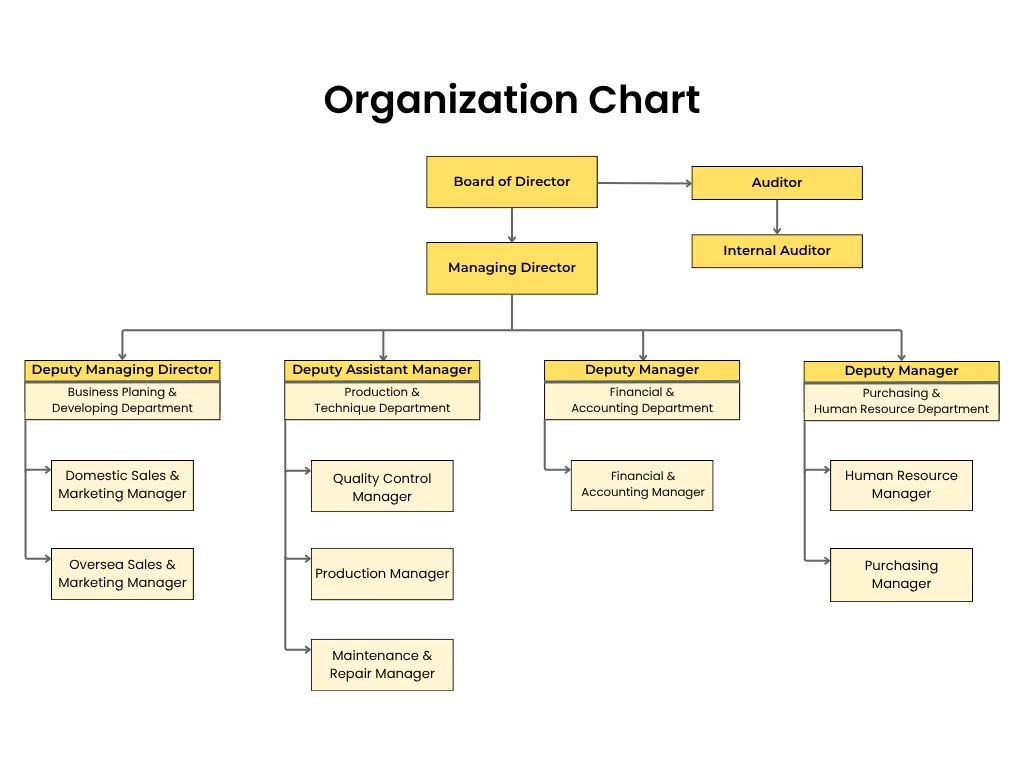
Management Team
Mr. Sumol Sereethoranakul
Managing Director
Miss. Araya Gampankaw
Deputy Managing Director
Mr. Sarun Sereethoranakul
Assistant Managing Director
Mr. Saravut Sereethoranakul
Assistant Managing Director
Mr. Sirin Sereethoranakul
Assistant Managing Director
Production Process
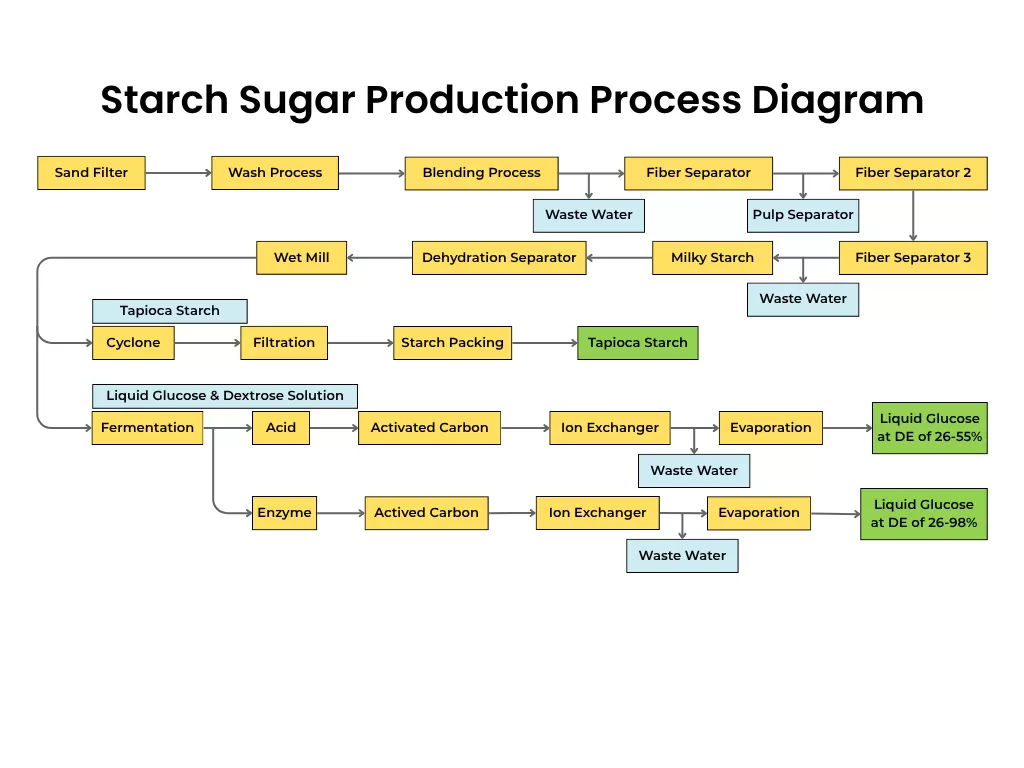
Wet Starch Production Process
Sand separator (Sieving and Washing)
Tapioca miller (Rasping)
Pulp Separator (Coarse Extractor)
Fine Pulp Separator (Fine Extractor)
The concentration of milky starch adjustment section
Centrifuge section (Centrifugal)
Tapioca Starch Production process
Flash Drying
Siever
Packing Section
Liquid Glucose and Dextrose Solution production process
Milky starch preparation
Fermentation
Activated Carbon
Ion Exchanger
Evaporation
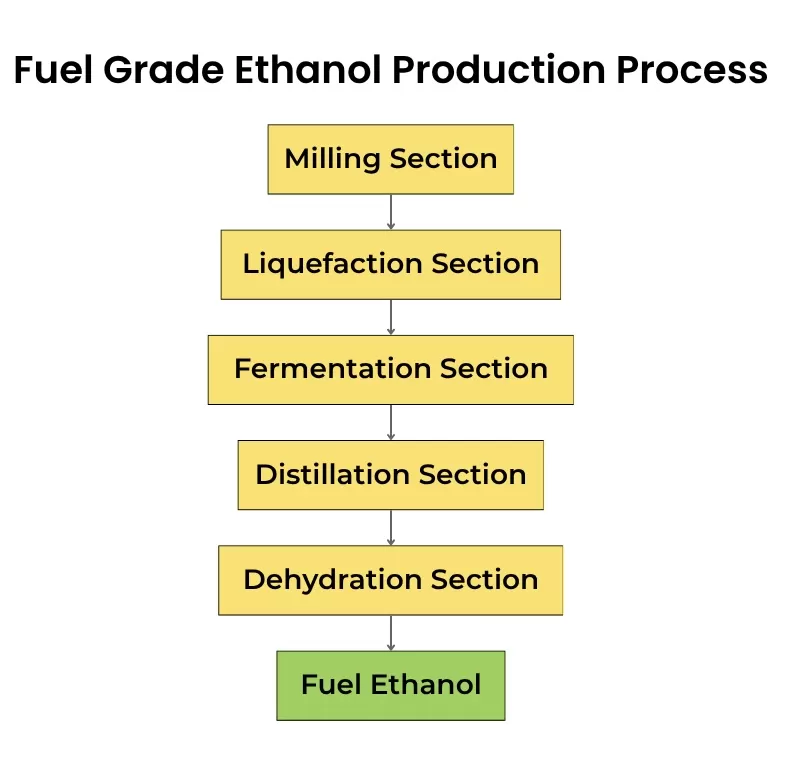
Fuel Grade Ethanol Production Process
Milling Section
Liquefaction section
Fermentation Section
Distillation Section
Dehydration Section
Environmental Commitment
At P.S.C. Starch Products, we believe that responsible manufacturing is essential for a sustainable future. Our commitment to environmental stewardship is embedded in every aspect of our operations, from raw material sourcing to final product delivery. We are proud to maintain Green Industry certification and actively work to reduce our carbon footprint through energy-efficient processes, waste minimization, and continuous improvement initiatives.
Dedicated to sustainable practices and reducing our environmental footprint
Green Industry Certified
We maintain Green Industry certification, demonstrating our commitment to environmentally responsible manufacturing practices and sustainable operations.
Carbon Footprint Reduction
Our facility implements energy-efficient technologies and processes to minimize carbon emissions while maintaining the highest product quality standards.
Waste Minimization
We optimize our production processes to reduce waste generation and maximize resource efficiency throughout our manufacturing operations.
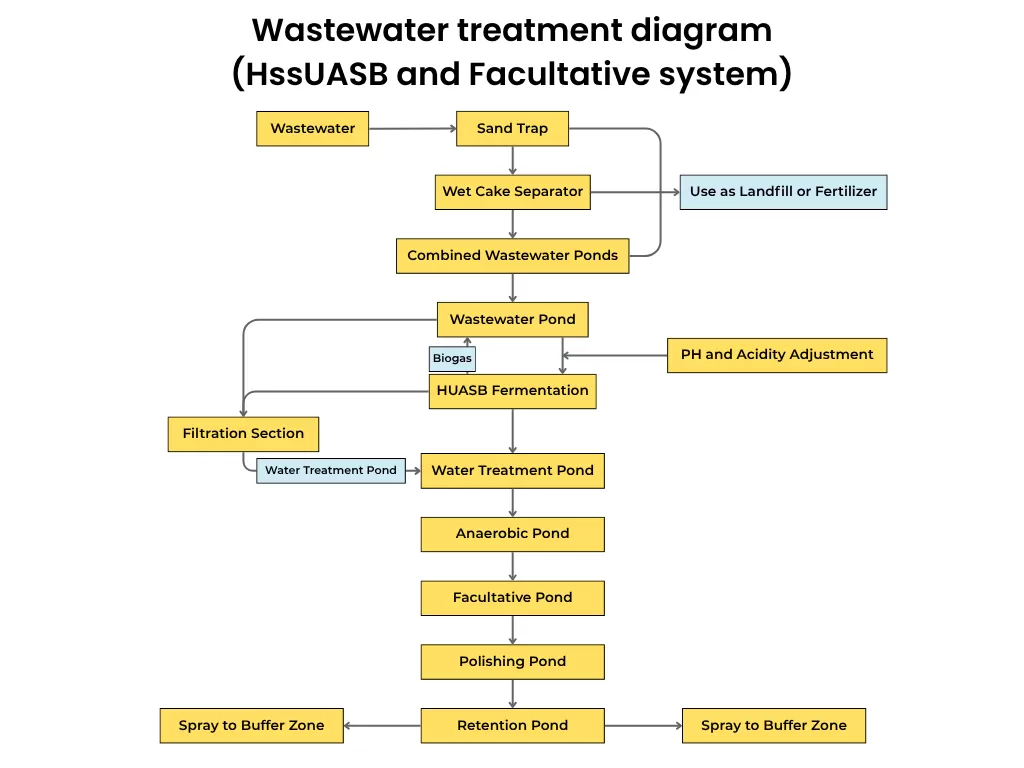
Wastewater
The wastewater created from production process comes from different sections which create approximately 5,000 Cubic Meters of wastewater per day. Our company combines wastewater into combined wastewater ponds by the gravity flow design before sending it to water treatment process. There are two types of wastewater treatments which are HssUASAB (High Suspension Solids Upflow Anaerobic Sludge Blanket) and Facultative pond. HssUASAB bio-gas system is a treatment system that digest molecules and create bio-gas which our company uses bio-gas to generate steam energy and generate electricity. After wastewater treatment has been treated, wastewater will be processed into the facultative system as the last process before spray it into our buffer zone.
After the wastewater has been processed from the facultative ponds, wastewater will be kept in retention pond to be sprayed to eucalyptus and palm oil plants in the plantation area of 1120 rais or 180 hectares. This shows that there are no wastewater pollution and none of the wastewater going out of the process.